English
 Spanish
 Portuguese

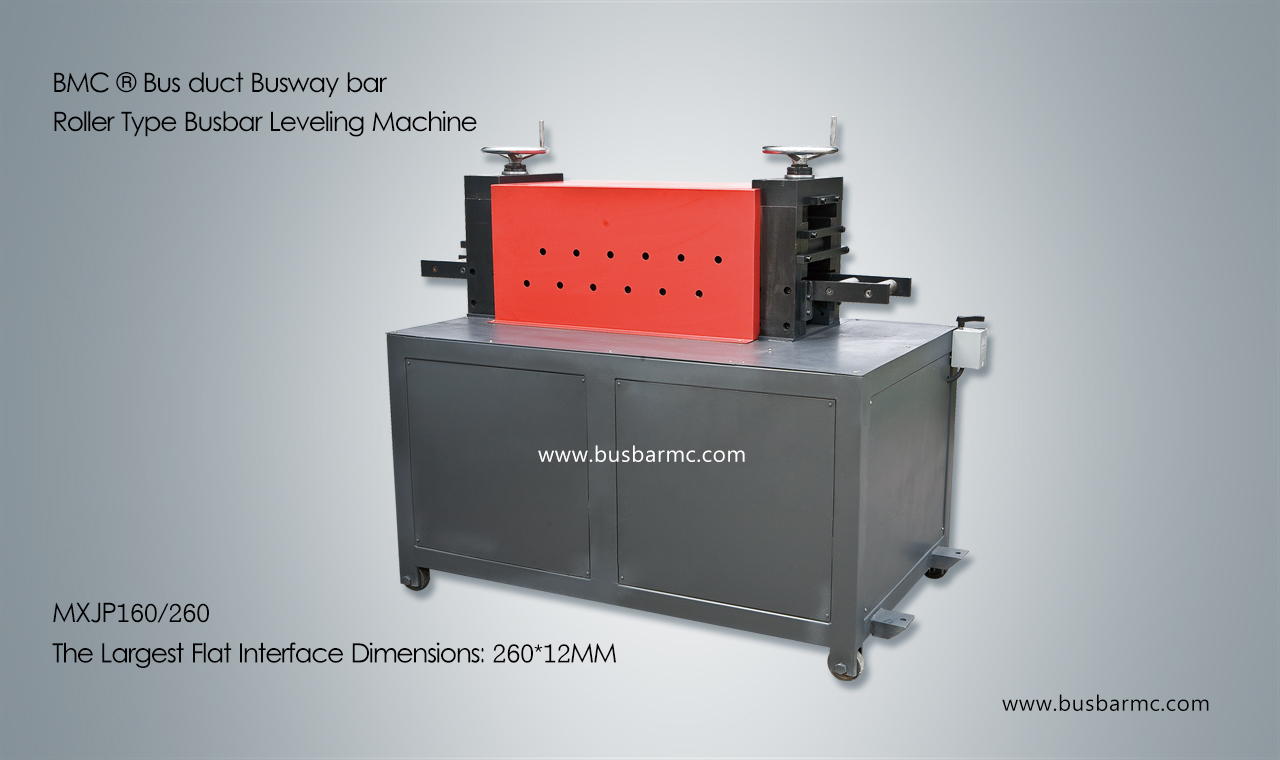
HX160-260 copper busbar leveling machine busbar bending machineMain Features:bus
The HX160-260 is the copper busbar leveling machine, used to flatten and straighten bars that arrive bent, twisted or uneven after cutting or transport. It is offered in two widths, with a 160 × 12 mm and a 260 × 12 mm working range, and two motor ratings of 3 kW and 5.5 kW. The wider version occupies 1,700 × 1,000 × 1,300 mm against 1,580 × 800 × 1,300 mm for the 160 mm version. Because leveling happens before punching and bending, the machine protects the flatness that the downstream panel assembly depends on. Typical application: panel and switchgear shops that receive coil or transport-damaged copper bar.
Values per the model datasheet. Each paragraph is self-contained and states the test condition, the value and the comparison baseline.
Test condition: a direct comparison between the two sizes of the HX160-260. Value: a 160 × 12 mm working range on the 3 kW version, occupying 1,580 × 800 × 1,300 mm, against a 260 × 12 mm range on the 5.5 kW version, occupying 1,700 × 1,000 × 1,300 mm. Comparison baseline: a single-width machine, which forces the purchase of a second unit when the bar width grows. Effect: the size is selected from the actual bar width, for the same 1,300 mm machine height and a 120 × 200 mm increase in footprint.
Test condition: leveling a 12 mm thick copper bar before it enters the punching and bending stages. Value: a 12 mm processing thickness in both widths, at 3 kW or 5.5 kW. Comparison baseline: punching and bending bar that is still curved from the coil, where the residual curvature shows up as an out-of-tolerance assembly. Effect: the flatness that downstream panel assembly relies on is restored at the entry of the process.
Test condition: processing bars across the panel-building width range. Value: 160 mm or 260 mm maximum width at a common 12 mm thickness. Comparison baseline: hand straightening with a mallet and a flat plate, which is not repeatable. Effect: leveling becomes a machine operation with a determinate width and thickness limit.
Test condition: placing the leveler in line with the punching and bending stations. Value: 1,580 × 800 × 1,300 mm on the 160 mm version and 1,700 × 1,000 × 1,300 mm on the 260 mm version. Comparison baseline: sending bars out for leveling, which adds transport and lead time. Effect: leveling is brought into the shop at a footprint smaller than a single 3-in-1 machine table.
It levels and straightens copper busbar, restoring flatness before the bar goes into punching and bending.
A 160 × 12 mm range at 3 kW (1,580 × 800 × 1,300 mm) and a 260 × 12 mm range at 5.5 kW (1,700 × 1,000 × 1,300 mm).
Because residual curvature from the coil or from transport shows up as an out-of-tolerance assembly once the bar is punched and bent.
HX160-260 copper busbar leveling machine busbar bending machine
Main Features:
This machine is roller type busbar leveling machine with Fast output,efficient,simple and convenient operation,can match the busbar processing machine Convenient and quick.
This machine is adopting curvature compensation technique.compared with the traditional roller type,the phenomenon of the workpiece slippage has been improved.reasonable stress.Save energy more than doubled. At the same time greatly extended the service life of the machine.
Power Of Motor
3KW/5.5KW
The Largest Flat Interface Dimensions
160*12MM/260*12MM
Size Of copper busbar machine
1580*800*1300mm/1700*1000*1300mm